Khashayar Shojaei-asanjan
Process of Engineering Design from Personal Experience
DNA fingerprinting is a technique that assists in the identification of organisms by their respective DNA profiles. This technique is used in various fields such as forensics, anthropology and biotechnology. This technique is also used in parental testing and criminal investigation. For example, in criminal investigation, a minute quantity of DNA present in the hair follicles or body tissues is collected from a crime scene. The PCR technique amplifies this minute quantity of DNA fragment for electrophoresis and a more visible bands in the DNA profile. DNA fingerprints are obtained by cutting DNA at specific base pairs by restriction enzymes and placing a voltage difference across the sample. Each band is a result of differing molecular sizes being attracted towards the anode in the electrophoresis apparatus. Usually, a gel electrophoresis examines the similarity of the DNA profile of one sample to other samples. The comparison is such that if the corresponding bands in one column is closely aligned with the bands in another column then the two profiles do indeed belong to a same sample.
There were two tasks to be completed during the lab: 1- The comparison of the DNA samples of two students with the control sample (which contained the ALU sequence) to determine the zygosity of each student 2- Having a DNA from crime scene and five samples from suspects, investigate the possibility of having the criminal among the suspects using gel electrophoresis technique. First, the restriction endonuclease, EcoR1, was used to cut the DNA samples of five segments at the respective restriction sites of EcoR1. Then the samples were mixed with glycerol to increase the density of the solution for better loading of the sample in agarose gel's wells. The solution was then mixed with the DNA loading dye to make it visible inside the gel and for better laoding of the sample into well. Next, the GelRed was added to DNA sample to make the fingerprints excitation under UV light exposure.
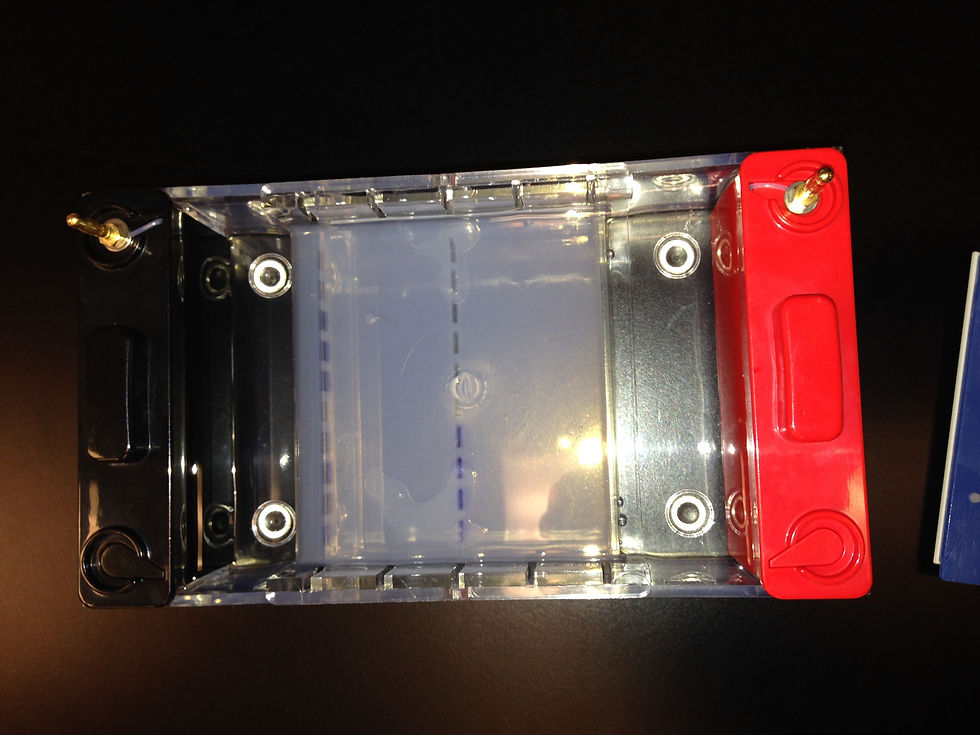
The next step was to prepare the agarose gel. First, the 1% agarose gel was dissolved in 100mL water by heating up the solution to the boiling point. Once the mixture became transparent and cooled to around 60C temperature , it was poured in the casting tray and the combs were inserted into middle and end of the tray for the formation of wells. Once the gel solidified, the 1X TAE buffer was added to electrophoresis chamber up to the fill line in the apparatus. The samples were then loaded with P20 pipettors and run under the uniform electric field(100V potential)created by connecting gel electrophoresis apparatus to a DC power supply.In the final step, the DNA fingerprints from electrophoresis were observed under the UV light excitation.
Forensic DNA Fingerprinting, Analysis of DNA Fragments by Electrophoresis


Attachment